

Why are regular eye tests so important?
It’s easy to neglect your eyes because they often do not hurt when there’s a problem.
Having an eye test will not just tell you if you need new glasses or a change of prescription – it’s also an important eye health check.
An optician can spot many general health problems and early signs of eye conditions before you’re aware of any symptoms, many of which can be treated if found early enough.
How often should I have an eye test?
The NHS recommends that you should get your eyes tested every 2 years (more often if advised by your ophthalmic practitioner or optometrist).
Find out if you can get an eye test for free on the NHS
What should I do if I notice a change in my sight?
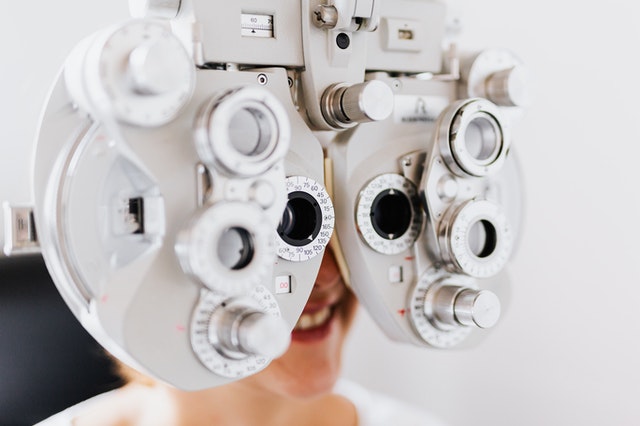
Visit an optician or GP if you’re concerned about any aspect of your vision at any time
Are some people more at risk from eye disease than others?
Some people are more at risk. It’s particularly important to have regular eye tests if you’re:
- older than 60
- from a certain ethnic group – people from African-Caribbean communities are at greater risk of developing glaucoma, for example, and people from south Asian and African-Caribbean communities are at greater risk of developing type 2 diabetes (diabetic retinopathy, where the retina becomes damaged, is a common complication of diabetes)
- someone with a learning disability
- from a family with a history of eye disease
What about my child’s sight?
Children often do not complain about their sight, but they may show signs of being unable to see properly.
Things to look out for include:
- sitting close to the TV
- holding objects very close to their face
- blinking a lot
- eye rubbing
- one eye turning in or out
- a white reflection in your child’s pupil
There are routine eye checks and tests for children but, if you think your child is having any sort of sight problems, take them to an optician for further investigation. NHS sight tests at opticians are free for children under 16 and for young people under 19 in full-time education.
Children do not have to be able to read letters to have their eyes examined.
Eye care tips for children
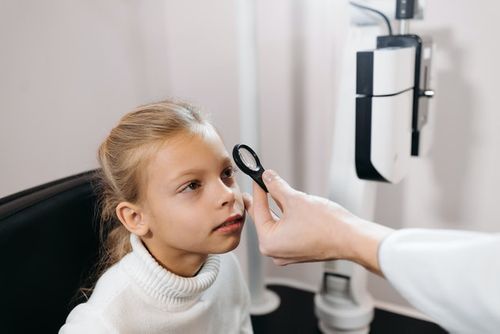
Although serious vision problems during childhood are rare, routine eye checks are offered to newborn babies and young children to identify any problems early on. Free NHS sight tests are also available at opticians for children under 16 and for young people under 19 in full-time education.

Eye care tips for over 60s
Because our eyesight changes as we get older, almost all of us will need to wear glasses or contact lenses by the time we're 65. If you have regular eye tests, wear the right lenses and look after your eyes, there's a better chance your sight will remain clear.
What else can I do to look after my eyes?
Give up smoking
If you smoke you’re much more likely to develop age-related macular degeneration, which is the most common cause of sight loss in the UK, and cataracts, than people who do not smoke.
For help quitting, check out the NHS 10 self-help tips to stop smoking.
Protect your eyes from the sun
Getting out in the sun is important for your general health, but you need to protect yourself.
Never look at the sun directly, even when something exciting such as an eclipse is happening. Doing so can cause irreversible damage to your eyesight and even lead to blindness. Several studies also suggest sunlight exposure is a risk factor for cataracts.
Wearing sunglasses can help protect your eyes from UV rays. The College of Optometrists recommends buying sunglasses. Look for glasses carrying the CE mark or the British Standard BS EN ISO 12312-1:2013, which ensures they offer a safe level of ultraviolet protection.
Content provided by NHS.uk
Find information and advice on health conditions, symptoms, healthy living, medicines and how to get help.

Why eye checks are important
The sooner any eye problem is found, the sooner you and your child will be able to get any treatment and support needed.
Children may not realise they have a vision problem so, without routine tests, there’s a risk a problem may not be spotted. This may affect their development and education.
If you have any concerns about your child’s vision see a GP or go to an opticians.
When will my child’s eyes be checked?
Your child’s eyes may be checked a number of times throughout the first hours, weeks and years of their life.
- Within 72 hours of birth
Your child’s eyes will be checked for any obvious physical problems as part of the newborn physical examination.
- Between 6 and 8 weeks old
This is a follow-up physical examination to check for any obvious problems that were not picked up soon after birth.
- Around 1 year, or between 2 and 2-and-a-half years
You may be asked if you have any concerns about your child’s eyesight as part of your child’s health and development reviews. Eye tests can be arranged if necessary.
- Around 4 or 5 years old
Your child’s eyes may be examined soon after they start school. This is called vision screening and it checks for reduced vision in one or both eyes. The aim is to detect any problems early so that treatment can be given if needed.
Vision screening is usually carried out in your child’s school. However, this does not happen in all areas. If your child’s vision is not checked at school, take them to your local opticians for an eye examination.
Speak to a GP or go to an opticians if you have any concerns about your child’s vision at any stage.
What tests may be carried out?
A number of tests may be carried out to check for vision or eye problems in babies and children.
The red reflex test
The red reflex test is usually carried out alongside a general examination of your baby’s eyes, as part of newborn checks.
It involves using an instrument called an ophthalmoscope that magnifies the eyes and uses a light so they can be examined clearly.
When light is shone into your baby’s eyes, a red reflection should be seen as it’s reflected back. If a white reflection is seen, it could be a sign of an eye problem.
The pupil reflex test
The pupil reflex test involves shining a light into each of your baby’s eyes to check how their pupils (black dots at the centre of the eyes) react to light.
Your baby’s pupils should automatically shrink in response to the light. If they don’t, it could be a sign of a problem.
Attention to visual objects
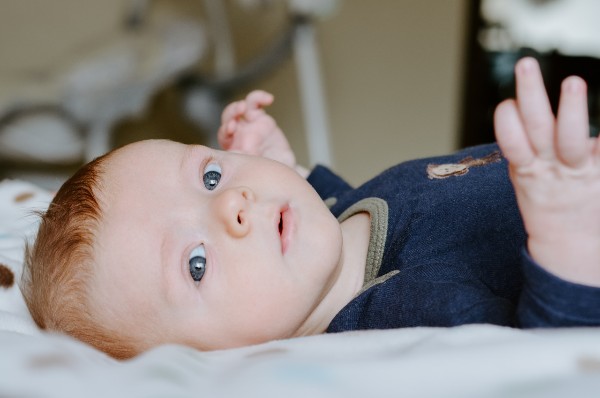
This is a simple test to check whether a newborn baby pays attention to visual objects.
A midwife or doctor will try to attract your baby’s attention with an interesting object. They then move it to see if the child’s eyes follow.
These sorts of tests can also be used to check the eyesight of older babies and young children who are not yet able to speak.
If your child can speak but is not yet able to recognise letters, pictures may be used instead of objects.
Range of movement tests
To test the range of movement of each eye, a child’s attention will be drawn to an interesting object, which is then moved to 8 different positions: up, down, left, right, and halfway between each of these points.
This tests how well the eye muscles work.
Snellen and LogMAR charts
When your child can recognise or match letters, their vision is tested using charts that have rows of letters and numbers of decreasing sizes.
Your child will be asked to read out or match the letters they can see from a specific distance. These charts are called Snellen or LogMAR charts.
For younger children, a similar test using pictures or symbols may be carried out instead.
Refraction test
A refraction test is carried out by an optometrist at a high-street opticians and is used to check if your child needs glasses and, if so, what prescription they need.
Before the test, your child may be given special eyedrops that widen their pupils so the back of their eyes can be examined more clearly.
Your child will be asked to look at a light, or read letters on a chart if they’re old enough, while different lenses are placed in front of their eyes.
Colour vision deficiency test
Colour vision deficiency tests, also known as colour blindness tests, are usually carried out in older children if a problem is suspected.
One of the tests used to check for colour blindness is the Ishihara test. This involves looking at images made up of dots in 2 different colours. If a child’s colour vision is normal, they’ll be able to recognise a letter or number within the image.
A child who can’t tell the difference between 2 colours won’t be able to see the number or letter, which means they may have a colour vision problem.
Read more about diagnosing colour vision deficiency.
Causes of eye problems in babies and children
There are a number of different eye problems that can be detected during eye tests, including:
- childhood cataracts – cloudy patches in the lens of the eye that are present from birth
- lazy eye (amblyopia) – where the vision in one eye does not develop properly
- squint (strabismus) – where the eyes look in different directions
- short-sightedness (myopia) – where distant objects appear blurred, while close objects can be seen clearly
- long-sightedness (hyperopia) – where you can see distant objects clearly but nearby objects are out of focus
- astigmatism – where the transparent layer at the front of the eye (cornea) is not perfectly curved
- colour vision deficiency (colour blindness) – difficulty seeing colours or distinguishing between different colours; this is more common in boys than girls
Spotting signs of an eye problem
Children can have an eyesight test at any age. They do not need to be able to read, or even speak. An eyesight test is particularly important if there’s a history of childhood eye problems, such as squint or lazy eye, in your family.
Although your child should have regular eye tests as they grow up, it’s still important to look out for signs of any problems and get advice if you have any concerns.
For babies, the checklist in your baby’s personal child health record (red book) can be used to help you check if your child’s vision is developing normally.
In older children, signs of a possible eye problem can include:
- the eyes not pointing in the same direction
- complaining of headaches or eye strain
- problems reading – for example, they may need to hold books close to their face and they may lose their place regularly
- problems with hand-eye co-ordination – for example, they may struggle to play ball games
- being unusually clumsy
- regularly rubbing their eyes
- sitting too close to the TV
Speak to a GP or go to an opticians if you have any concerns about your child’s eyes or vision. The earlier a problem is picked up the better.
Content provided by NHS.uk
Find information and advice on health conditions, symptoms, healthy living, medicines and how to get help.
Published on Thu, 27 Jan 2022 11:30:21 GMT
Modified on Mon, 04 Apr 2022 12:50:44 GMT
Have regular eye tests
An eye test is not just good for checking whether your glasses are up-to-date. It’s also a vital check on the health of your eyes.
An eye test can pick up eye diseases, such as glaucoma and cataracts, as well as general health problems, including diabetes and high blood pressure.
The good news is that if you’re 60 or over, you can have a free NHS eye (sight) test as often as you need one.
This is normally every 2 years, but may be more often in certain circumstances.
Your optometrist will be able to advise you as to how often you need to be seen.
If you can’t leave your home because of illness or disability, you can have an NHS eye test at home.
Contact your usual optician to find out if they can visit you at home.
Otherwise, NHS England will have a list of opticians in your area that do home visits.
Wear the right lenses
An eye test will establish whether you need a different prescription for your glasses or contact lenses.
It’s important to wear the correct prescription lenses. This will improve your quality of life and reduce the risk of accidents such as falls.
You may be entitled to help with the cost of NHS glasses or contact lenses, so ask your optician about this.
How to keep your eyes healthy
As well as having regular eye tests and wearing the correct glasses, there are several things to keep your eyes as healthy as possible.
Eat well
Eating a healthy, balanced diet is important for your eyes.
Eating plenty of vegetables and fruit will benefit your overall health and may help protect against some conditions, such as cataracts and age-related macular degeneration (AMD).
Wear sunglasses
Strong sunlight can damage your eyes and may increase your risk of cataracts. Wear sunglasses or contact lenses with a built-in UV filter to protect your eyes from harmful rays.
Quit smoking
Smoking can increase your chances of developing conditions such as cataracts and AMD.
Stay a healthy weight
Being overweight increases your risk of diabetes, which can lead to sight loss.
Exercise
Good circulation and oxygen intake are important for our eye health. Both of these are stimulated by regular exercise.
Sleep well
As you sleep, your eyes are continuously lubricated and irritants, such as dust or smoke, that may have accumulated during the day are cleared out.
Use good lighting
To see well, your eyes need 3 times as much light when you’re 60 as they did when you were 20.
Increase the daylight in your home by keeping windows clean and curtains pulled back.
Make sure you have good electric lighting, too, especially at the top and bottom of stairs so you can see the steps clearly.
For reading or close work, use a direct light from a flexible table lamp, positioned so the light isn’t reflected by the page and causing glare.
Eye problems as you get older
As you get older, you become more likely to get certain eye problems.
Difficulty reading
Eye muscles start to weaken from the age of 45. It’s a natural ageing process of the eye that happens to us all.
By the time you’re 60, you’ll probably need separate reading glasses or an addition to your prescription lenses (bifocals or varifocals).
Floaters
Floaters, which are tiny specks or spots that float across your vision, are normally harmless.
If they persist, see an optician as they may be a sign of an underlying health condition.
Glaucoma
Glaucoma is related to an increase in pressure in the eye that leads to damage of the optic nerve, which connects the eye to the brain.
Left untreated, glaucoma leads to tunnel vision and, ultimately, blindness.
But if it’s detected early enough, these complications can usually be avoided with eye drops.
Macular degeneration
Macular degeneration is a disease of the retina caused by ageing. The retina is the nerve tissue lining the back of your eye.
There are 2 types of macular degeneration. The first type, called dry macular degeneration, gets worse very slowly.
The other type gets worse very quickly. This needs to be seen as an emergency in a hospital eye unit for prompt treatment.
Content provided by NHS.uk
Find information and advice on health conditions, symptoms, healthy living, medicines and how to get help.
Published on Thu, 27 Jan 2022 11:32:50 GMT
Modified on Tue, 19 Dec 2023 14:50:59 GMT
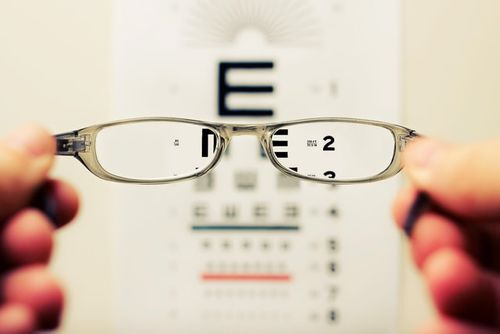
Ophthalmic practitioners prescribe and fit glasses and contact lenses. If necessary, they’ll refer you to a GP or a hospital eye clinic for further investigations. Sometimes, you’ll be referred to a specialist optometrist for a referral refinement (reassessment).
How often should I have a eye test?
Your eyes rarely hurt when something is wrong with them, so having regular eye tests is important to help detect potentially harmful conditions.
The NHS recommends that you should have your eyes tested every 2 years (more often if advised by your ophthalmic practitioner or optometrist).
An NHS sight test is free of charge if you’re in one of the eligible groups and the test is considered clinically necessary. If the ophthalmic practitioner cannot see a clinical need, you’ll have to pay for the test privately.
Private sight tests
If you’re not eligible for a free NHS sight test, you’ll have to pay for a private test.
Charges for private sight tests vary, so it’s advisable to shop around.
If you pay for a private sight test, you won’t be eligible for a free NHS sight test until your next sight test is due.
This will usually be 2 years later, but could be sooner in some cases. The person testing your sight can advise you.
Find out more about free NHS eye tests and optical vouchers.
What happens after an eye test?
Following an eye test your ophthalmic practitioner is legally required to give you your optical prescription or a statement to say you’ve been referred for further tests.
An NHS optical voucher will also be issued immediately if you can prove you’re entitled to one. There are currently 10 voucher values for glasses and lenses. The values depend on the strength of your prescription. The stronger your prescription, the higher the value of your voucher.
You should never feel obliged to buy glasses or redeem an optical voucher from the place where you had your eye test. Shop around for the best value and only buy glasses or contact lenses when you’re happy with the product and cost.
Why does the optician not give me my pupillary distance?
Your ophthalmic practitioner or optometrist is not required by law to include details of the horizontal distance between your pupils (the inter-pupillary distance) in your prescription.
The responsibility for ensuring the lenses are properly centred in your frames lies with the person fitting your glasses (dispensing optician), and they’ll have to do all the measuring.
Any provider of glasses, whether shop- or internet-based, should have arrangements in place to be able to satisfy this requirement.
Eye healthcare professionals explained
Optometrists
An optometrist is trained to recognise abnormalities in your eyes.
They examine the internal and external structure of your eyes to detect conditions such as glaucoma, macular degeneration and cataracts.
They may also test your ability to focus and coordinate your eyes and see depth and colours accurately. If necessary, the optometrist will refer you to your GP or a hospital eye clinic for further investigations.
Optometrists can prescribe and fit glasses, contact lenses and low vision aids, and, if trained to do so, medicines to treat eye conditions.
Dispensing opticians
Dispensing opticians fit glasses and contact lenses working from the prescriptions written by an ophthalmic practitioner or ophthalmologist. They also fit and dispense low vision aids such as magnifying glasses or telescopic spectacles. They do not do eye tests.
A dispensing optician can give you advice on types of lenses, such as single-vision or bifocal (lenses with 2 distinct optical powers) and help you to choose frames and other optical aids. They can also give you advice about wearing and caring for your glasses or contact lenses.
Orthoptists
Orthoptists are specialists in squints and eye movement disorders. They investigate and identify problems relating to the development of the visual system, including:
- squint and lazy eyes in children (orthoptists often do vision screening of children in schools and community health centres)
- adults with learning difficulties
- adults with double vision or a binocular vision problem
Opthalmologists
Ophthalmologists (eye surgeons) are doctors that specialise in the medical and surgical care of the eyes and visual system.
They also look into the prevention of eye disease and injury. An ophthalmologist treats people of all ages, from premature babies to the elderly.
Conditions dealt with in ophthalmology can include eye trauma, cataracts, diabetic eye conditions such as diabetic retinopathy, as well as congenital and genetic eye problems.
Ophthalmic medical practitioners
Ophthalmic medical practitioners are medically qualified doctors specialising in eyecare.
Like optometrists, they examine eyes, test sight, diagnose abnormalities and prescribe suitable corrective lenses.
How can I make a complaint?
If you’re not happy with the service or treatment provided, you have the right to make a complaint.
Wherever possible, complaints should be made directly to the practice as it may be possible to sort out the problem straight away.
- If you would prefer to talk to someone who is not involved with the practice concerned, you can complain to NHS England. Find out about the NHS complaints procedure.
- The Optical Consumer Complaints Service (OCCS) may also be able to give you advice or provide some mediation.
Content provided by NHS.uk
Find information and advice on health conditions, symptoms, healthy living, medicines and how to get help.
Published on Thu, 27 Jan 2022 11:34:47 GMT
Modified on Fri, 01 Dec 2023 11:12:21 GMT
Content provided by NHS.uk
Find information and advice on health conditions, symptoms, healthy living, medicines and how to get help.
Published on Thu, 27 Jan 2022 11:22:28 GMT
Modified on Wed, 20 Dec 2023 16:16:50 GMT